When it comes to adiabatic evaporative cooling for industrial environments, attention is often focused on cooling performance and the ability to reduce air temperature. However, there is another element that plays a fundamental role in the proper operation of the system: water.
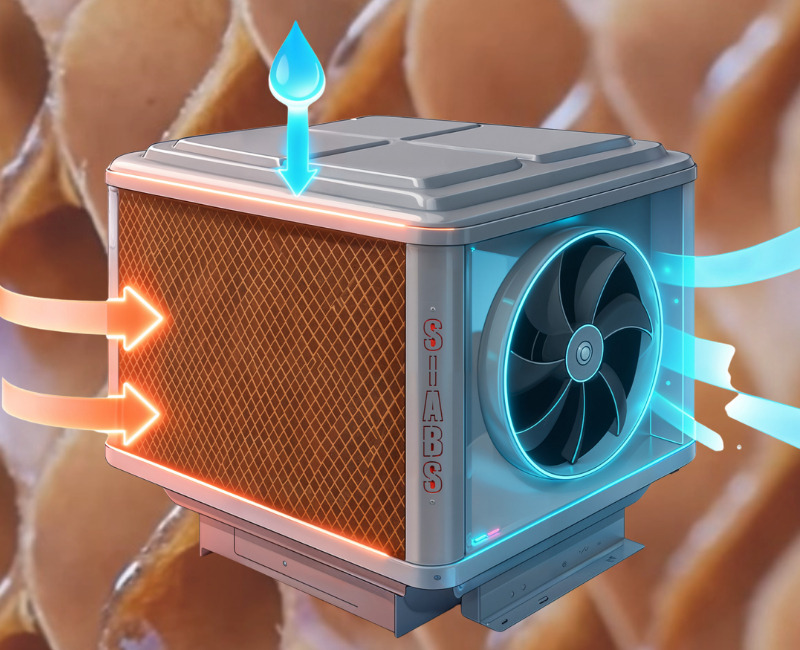
In direct evaporative cooling systems, water is an integral part of the process. Warm air from outside passes through moistened evaporative pads and, thanks to the natural evaporation process, releases part of its heat. The air is therefore cooled before being introduced into the environment.
However, to achieve consistent performance over time, it is not enough to simply use water and evaporative pads. The entire water circuit must be properly managed, from the initial filling stage through water renewal, drainage and drying.
It is precisely within this balance between cooling, water consumption, maintenance and circuit management that SIABS STAY COOL technology comes into play.
How the STAY COOL Water Circuit Works
During operation, water is distributed over the evaporative pads, keeping them constantly wet and allowing warm air to pass through them.
Part of the water naturally turns into vapour during the evaporation process. The water that does not evaporate is collected in the tank and recirculated, making it possible to make use of the water already present in the system.
This principle combines the natural cooling of the air with the controlled use of water resources.
Managing the water level and supply circuit also helps maintain the system under the correct operating conditions, reducing the risk of malfunctions and contributing to the protection of its components.
More Than Just Cooling: Intelligent Water Management
In a production environment, an air cooler may operate for many consecutive hours and over extended periods during the hot season.
This is why water management becomes particularly important.
Proper management therefore involves monitoring the main stages of the cycle:
- water supply;
- wetting of the evaporative pads;
- recirculation;
- water renewal;
- drainage;
- cleaning;
- drying.
The goal is to keep the circuit in optimal condition, limiting the build-up of residues and helping to preserve the system’s efficiency over time.
The Role of Evaporative Pads
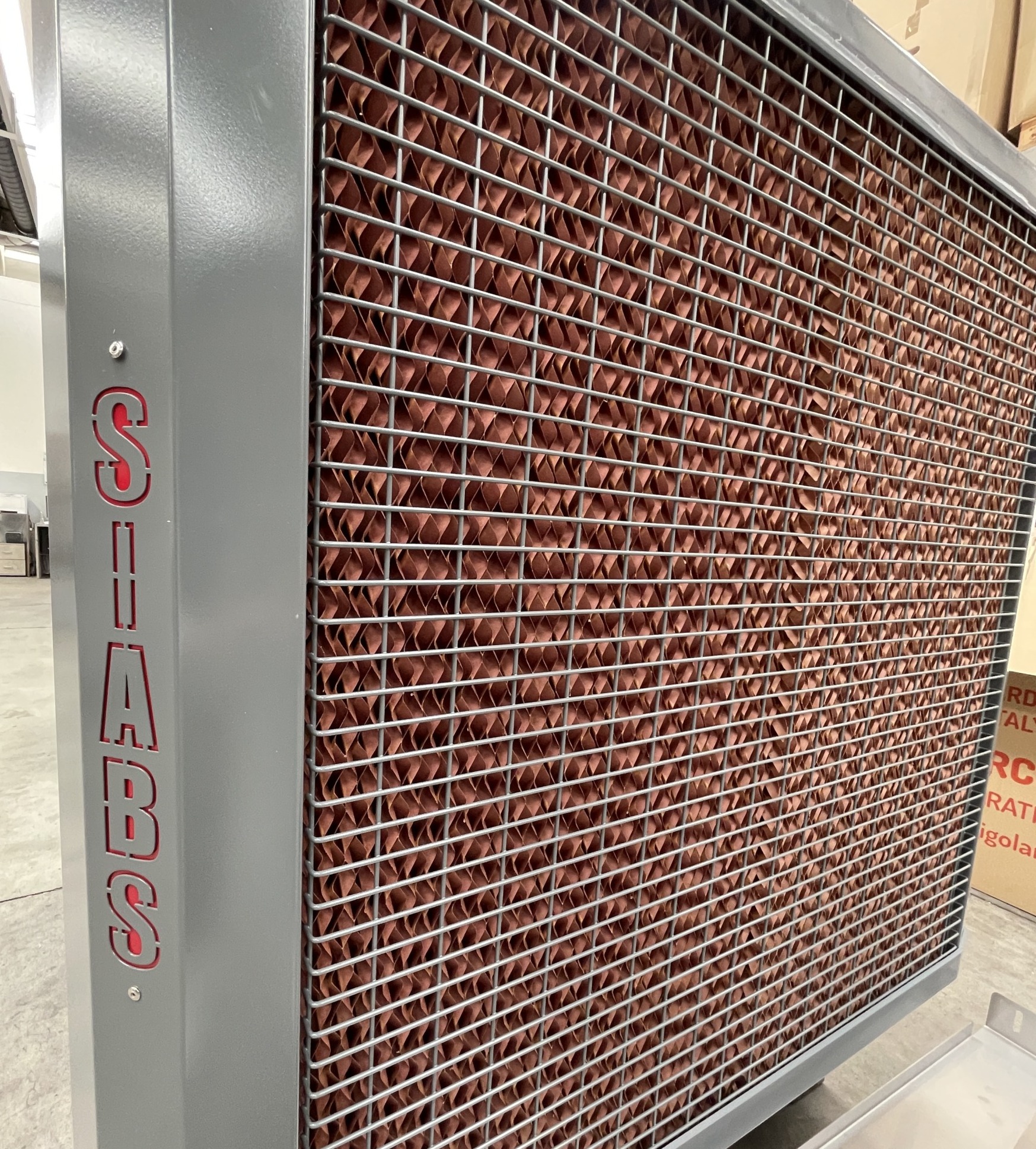
Evaporative pads are at the heart of the adiabatic cooling process.
Their efficiency depends on the ability to maintain the correct distribution of water across their surface and to ensure the passage of air through the evaporative material.
The presence of deposits, impurities or limescale build-up can negatively affect air circulation and the evaporation process.
For this reason, maintenance and proper water circuit management are closely linked to the overall performance of the system.
With STAY COOL, the aim is to offer a solution designed for the cooling of industrial environments, combining performance, ease of management and attention to operational efficiency.
Less Waste, Greater Efficiency
One of the most important aspects in the design of an evaporative cooling system is finding the right balance between cooling performance and water consumption.
From this perspective, STAY COOL technology makes it possible to take advantage of the evaporative cooling principle efficiently, adapting the system’s operation to the specific requirements of the environment.
When weather conditions allow, it is also possible to use simple ventilation, avoiding the unnecessary activation of the evaporative cooling process.
The result is a more rational use of resources and a system that can help reduce overall consumption.
Evaporative Cooling and Hygiene: Why Circuit Management Matters
Proper water management is also important from a hygiene perspective.
In any system that uses water, it is essential to avoid conditions of prolonged stagnation and to ensure appropriate management of the circuit.
For this reason, when managing an industrial evaporative air cooler, it is important to consider the system as a whole: not only its ability to cool the air, but also the way in which water is used, recirculated and managed throughout the entire operating cycle.
6 Aspects to Consider Before Choosing an Industrial Evaporative Cooler
When evaluating a solution for cooling a production environment, it is useful to consider several technical aspects.
1. Recirculation Management
Water that does not evaporate can be collected and recirculated, helping to optimise the system’s operation.
2. Evaporative Pad Maintenance
Regular cleaning and inspection of the evaporative pads are essential to preserve proper air circulation and the efficiency of the evaporation process.
3. Drainage Management
Water drainage must be properly managed to avoid prolonged stagnation and keep the circuit in suitable operating conditions.
4. Consumption Optimisation
An efficient system should use water and energy according to the actual requirements of the environment to be cooled.
5. Adaptation to Climatic Conditions
Outdoor temperature and air conditions influence the performance of evaporative cooling. The solution should therefore be sized according to the specific context.
6. Customised Design
Every industrial environment has different characteristics. Surface area, ceiling height, layout, production activities, air changes and climatic conditions must all be evaluated in order to identify the most suitable configuration.
STAY COOL: Evaporative Cooling Designed for Industry
With STAY COOL, SIABS offers an adiabatic evaporative cooling solution designed to help improve comfort in industrial and production environments during the hottest months.
The system can be configured to serve specific work areas or larger sections of a building, according to the characteristics of the environment and the requirements of the activity.
The SIABS approach is based on a simple principle: a good cooling system should not simply lower the temperature, but should be designed by considering the entire environment and how it is actually used.
For this reason, before choosing an evaporative cooler, it is important to carefully assess the installation context, the characteristics of the building, the type of activity carried out and the climatic conditions.
Would you like to find out whether STAY COOL is the right solution for your industrial environment?
The SIABS team can support you in evaluating the solution best suited to the characteristics of your facility, production area or workspace.
Contact us for a technical consultation and discover how STAY COOL can help improve summer comfort in your working environment.