Large spaces, high ceilings, frequently opened doors, air changes and distributed work areas: heating an industrial environment is not the same as heating an office or a residential building.
When evaluating a heating system for an industrial warehouse, one of the first questions to ask is: is it more efficient to heat the entire volume of air or to deliver heat directly to the areas where it is needed?
This is precisely the context in which SIABS gas-fired radiant tube heaters represent a particularly suitable solution.
Heat pumps can be an efficient technology, but in large industrial environments they must deal with certain characteristics typical of production facilities that can make heating the entire volume less advantageous.
The Main Issue: An Industrial Warehouse Is Not a Residential Building
An industrial warehouse may have:
- areas covering thousands of square metres;
- internal heights exceeding 6, 8, 10 metres or more;
- large industrial doors;
- frequent openings for the movement of vehicles and materials;
- high air-change rates;
- areas that are only partially occupied;
- departments with different thermal requirements;
- insulation that is often not comparable to that of a newly constructed building.
Under these conditions, the goal should not necessarily be to maintain every cubic metre of the building at the same temperature.
It is often much more rational to focus on the occupied zone and the areas where work is actually being carried out.
And this is where the approach of a heat pump differs significantly from that of radiant heating.
Heat Pumps: Heating the Air Volume
A heat pump transfers thermal energy into the environment and, in air-based configurations, uses air as the main medium for distributing heat.
In a large industrial warehouse, this means treating a very large volume of air.
The greater the height of the building, the larger the volume that needs to be brought to and maintained at suitable thermal conditions.
In addition, warm air naturally rises. In high-ceilinged buildings, this can lead to thermal stratification, with higher temperatures in the upper part of the building than in the occupied zone.
As a result, part of the energy is used to heat a volume that may have little relevance from an operational standpoint.
And what happens when a large industrial door is opened?
This is a daily occurrence in many industrial facilities.
A truck enters or leaves, a forklift moves through the department, or a door remains open during loading and unloading operations.
Indoor air is rapidly replaced by outdoor air.
For a system that relies primarily on air to transfer heat, this represents a particularly demanding condition: part of the thermal energy accumulated in the air is lost together with the air exchange.
The issue is therefore not simply how efficient the unit is under nominal conditions, but how effective the entire system is under the actual operating conditions of the industrial building.
Radiant Tube Heaters: Delivering Heat Directly Where It Is Needed
The operating principle of radiant tube heaters is different.
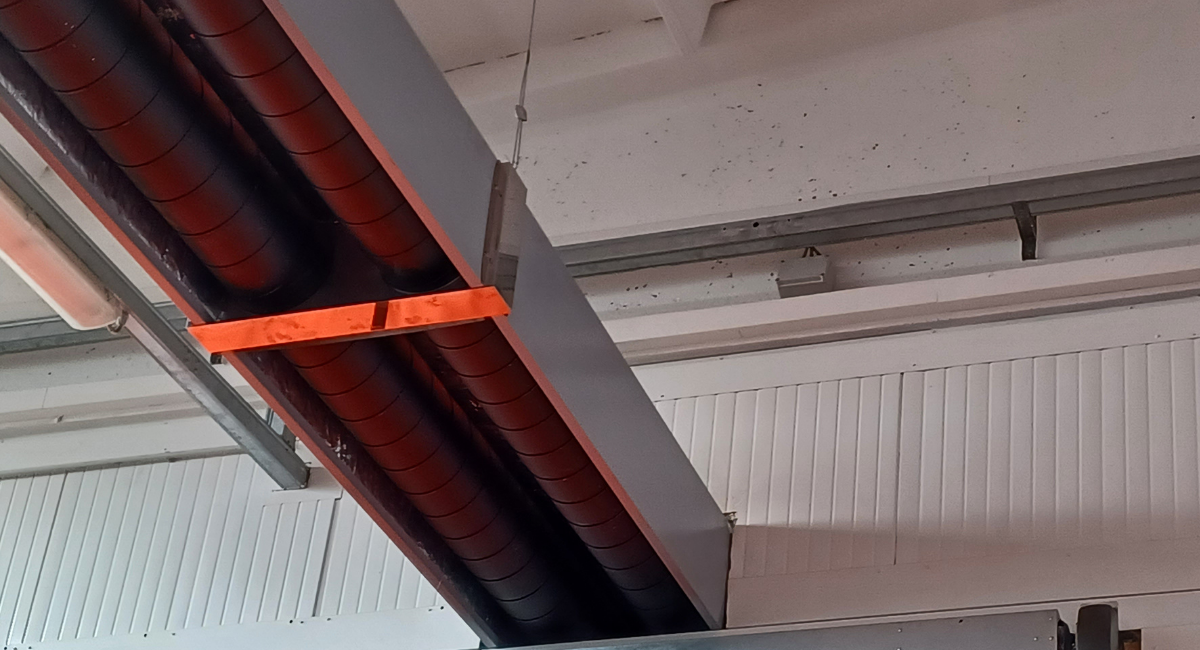
The SIABS system uses a heat generator connected to a radiant circuit generally installed on the ceiling.
The heat produced by the generator is transferred to the circuit, and the surface of the tubes reaches the temperature required to emit infrared radiation towards the environment below.
The radiant energy directly reaches:
- floors;
- machinery;
- surfaces;
- workstations;
- people present in the heated area.
The distribution of heat therefore does not rely exclusively on heating and moving the entire volume of air.
The Key Advantage: You Don’t Need to Heat the Entire Warehouse
Imagine a 10-metre-high warehouse where people mainly work within the first 2–3 metres.
With an air-based system, the total volume of the building inevitably becomes part of the thermal equation.
With a radiant system, however, it is possible to design the distribution of energy according to the areas that are actually occupied.
This makes it possible to adopt a zoned heating approach.
A production department may require a specific temperature, while a sparsely occupied storage area may have different requirements.
The system can therefore be sized and controlled according to the actual needs of the facility.
5 Reasons Why Radiant Heating Is Particularly Suitable for Industrial Warehouses
1. High Ceilings
In high-ceilinged warehouses, convective heating has to deal with the natural stratification of air.
Radiant heating, on the other hand, transfers energy towards the surfaces below through infrared radiation, making it particularly suitable for environments with high internal ceilings.
2. Frequently Opened Industrial Doors
In logistics and production facilities, openings are often unavoidable.
Radiant heat does not depend exclusively on warm air remaining inside the building volume.
The surfaces and elements within the irradiated area receive energy directly, helping maintain the thermal conditions of the area concerned even in the presence of frequent air changes.
3. Localised Heating
Not all areas of an industrial warehouse are necessarily occupied in the same way.
With radiant tube heaters, it is possible to design heating zones, concentrating energy where operators and production activities are located.
4. Reduced Effects of Thermal Stratification
Heat transferred through radiation does not need to be transported downwards by air circulation.
This reduces dependence on the convective dynamics typical of air-based heating, which are particularly relevant in large-volume buildings.
5. No Need to Occupy Floor Space
Radiant circuits are normally installed on the ceiling, leaving the floor available for:
- production lines;
- shelving;
- material-handling vehicles;
- machinery;
- storage areas.
For an industrial facility, this is also an important design consideration.
But Does This Mean That Heat Pumps Are Not Efficient?
Not necessarily.
Heat pumps can be a highly efficient solution, particularly in well-insulated buildings, with contained volumes, relatively stable temperatures and low air-change requirements.
The point is different: the efficiency of the unit does not automatically correspond to the efficiency of the entire heating system when applied to a specific building.
In an industrial warehouse, it is also necessary to consider:
volume to be heated + height + heat losses + openings + air changes + actually occupied areas + climatic conditions + available electrical capacity.
It is the combination of these factors that determines which technology is actually suitable.
SIABS Radiant Tube Heaters: Designed for Large Volumes
The SIABS radiant tube heating systems are specifically designed for applications where heating large spaces requires targeted energy distribution.
The I-RAD range includes systems with outputs from 80 to 300 kW, configurable according to the characteristics of the building and the user’s requirements.
The system integrates:
- heat generator;
- radiant tube circuit;
- exhaust and air intake system;
- temperature control system;
- configuration of the radiant lines according to the environment.
The goal is not simply to increase air temperature, but to transfer thermal energy directly to the area that needs to be heated.
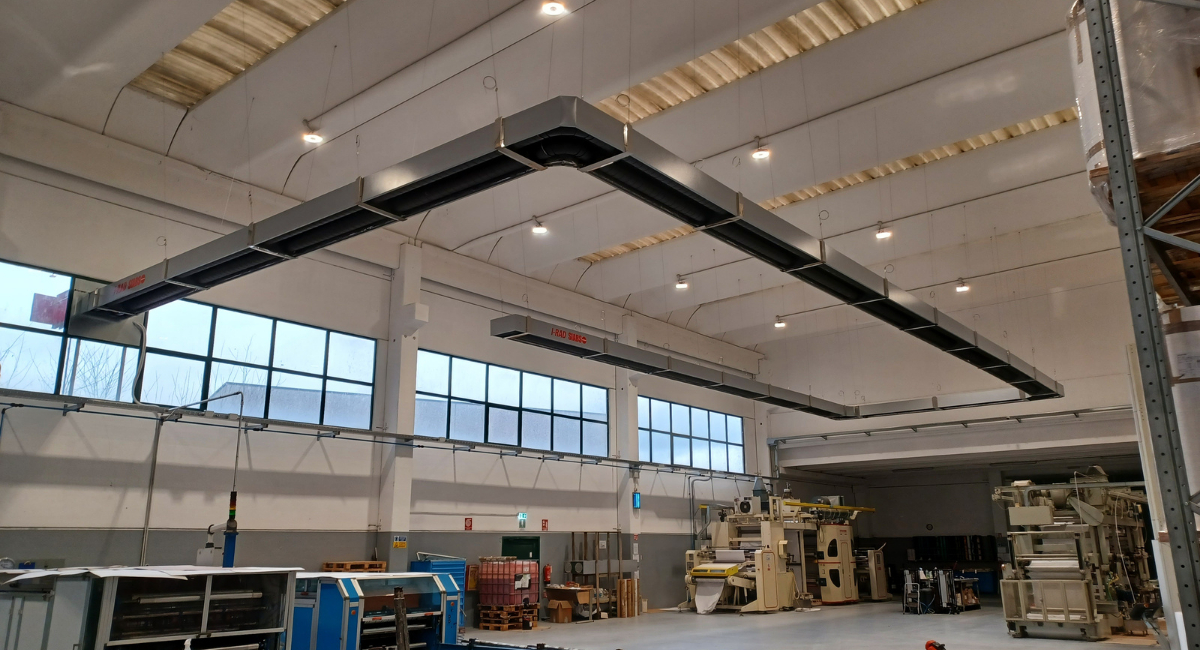
Heat Pump vs. Gas-Fired Radiant Tube Heaters for Industrial Heating
| Feature | Heat Pump | Gas-Fired Radiant Tube Heaters |
|---|---|---|
| Operating principle | Heats the air through a heat exchanger | Converts gas energy into infrared radiation |
| Heating method | Mainly heats the air | Direct heating of people, surfaces and work areas |
| Large-volume spaces | Must treat a large quantity of air | It is not necessary to heat the entire air volume |
| Warehouse height | Warm air tends to stratify towards the ceiling | Radiant heat reaches occupied areas directly |
| Work areas | Generally heats a larger volume | Heat can be concentrated where it is needed |
| Frequently opened doors | Open doors rapidly disperse heated air | Less dependent on building envelope airtightness, because heat is transferred through radiation |
| Air changes / extraction systems | May increase losses associated with heated air | Radiant heating continues to act on surfaces and people |
| Thermal stratification | Possible accumulation of warm air in the upper part of the building | Reduced dependence on air stratification |
| Localised heating | Less immediate | Particularly suitable for specific operational areas |
| Response time | Depends on the system and the volume to be brought up to temperature | Radiant heat is directly perceived in the areas concerned |
| Zoning | Possible, but requires system design | High flexibility in managing different zones |
| Installation in existing warehouses | May require indoor/outdoor units, distribution systems and adaptations | System can be installed at height, with distribution along the areas to be heated |
| Energy source | Electricity | Natural gas or LPG, depending on the configuration |
| Effectiveness in industrial environments | Strongly depends on insulation, volume and operating conditions | Particularly suitable for large spaces, warehouses and production areas |
| Comfort in the work area | Depends on air distribution | Heat is perceived directly in the occupied area |
There is no single best technology. There is the technology that is most suitable for the building.
The choice of a heating system should not start with the most modern technology or the declared efficiency of an individual unit.
It should start with the actual characteristics of the environment to be heated.
In an industrial warehouse characterised by large volumes, high ceilings, frequent openings and the need to primarily heat occupied areas, the radiant principle offers a fundamental advantage: it delivers energy where it is needed, without necessarily having to heat the entire volume of air.
In an industrial warehouse, you don’t need to heat everything. You need to heat where it matters.
Gas-fired radiant tube heaters use infrared radiation to deliver heat directly to work areas, making them a particularly suitable solution for the needs of large industrial environments.
This is why SIABS gas-fired radiant tube heaters represent a particularly effective solution for industrial heating in large spaces.