When summer arrives, heat can become a real problem in industrial environments for people working every day inside factories, warehouses and production areas.
In these settings, adiabatic evaporative cooling represents a particularly interesting solution for improving thermal comfort by exploiting a natural principle: water evaporation.
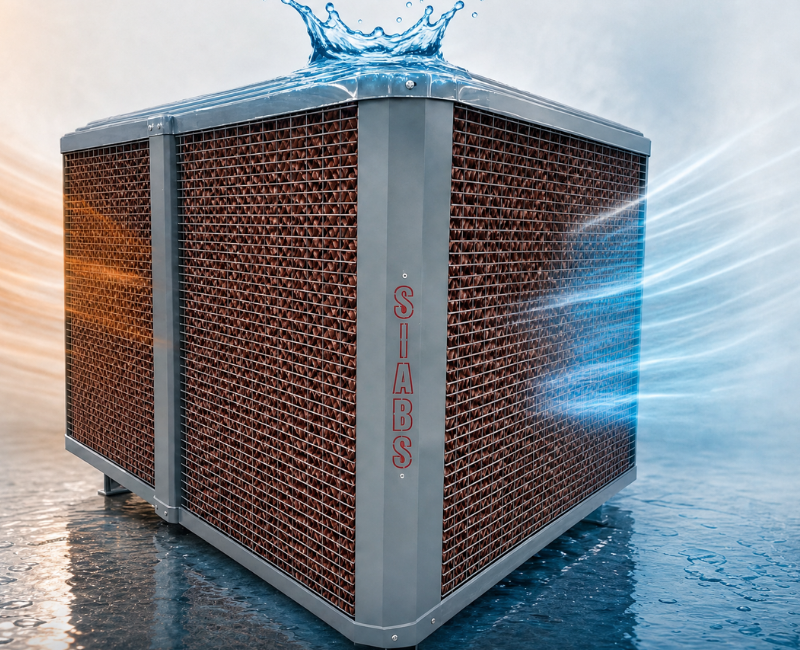
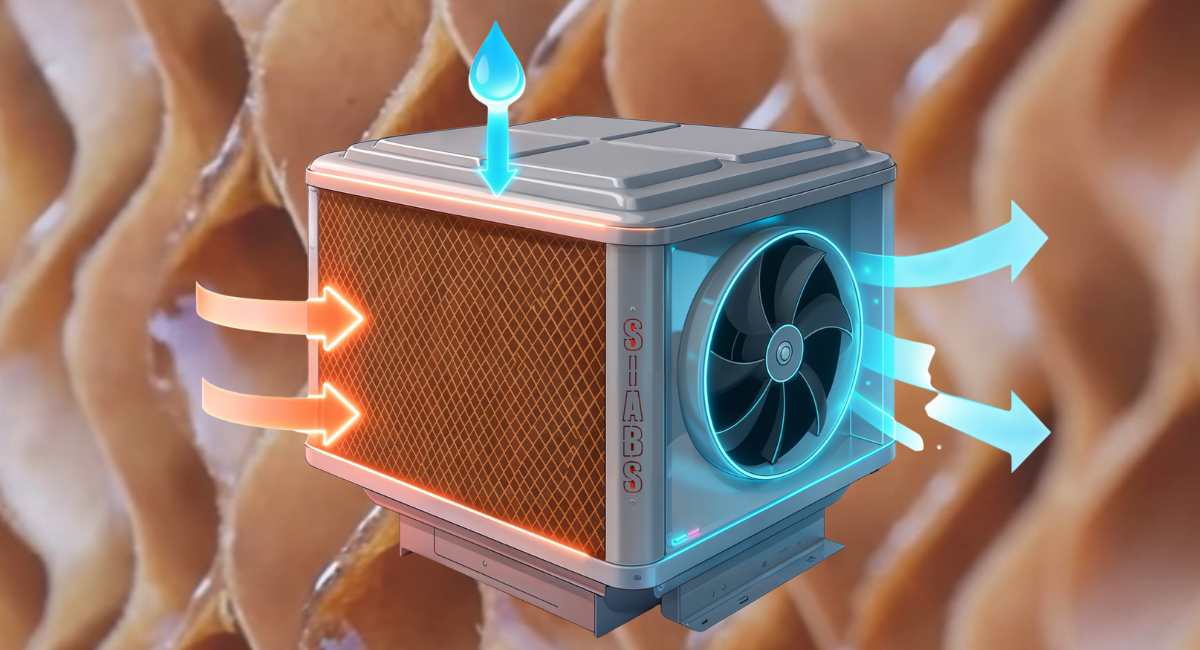
Water is, in fact, what makes the cooling process possible. Hot outdoor air is drawn into the system and passes through specially designed evaporative cooling pads that are kept wet. During this process, part of the water evaporates and removes heat from the air, which is therefore cooled before being released into the environment.
With the STAY COOL range, SIABS brings this principle to industrial and production environments, offering different configurations and airflow capacities to adapt to the characteristics of different spaces.
The Role of Water in Evaporative Cooling
Unlike traditional air conditioning systems, evaporative cooling uses water as a fundamental element in the heat exchange process.
The operation is simple:
- hot air is drawn in from outside;
- water wets the evaporative cooling pads;
- air passes through the wet pads;
- part of the water evaporates;
- heat is absorbed from the air during the evaporation process;
- the cooled air is released into the environment.
The principle is natural and makes it possible to achieve effective cooling in industrial environments through a system designed to handle high air volumes.
How Much Water Does a STAY COOL Evaporative Cooler Consume?
Water consumption is one of the aspects to consider when choosing an industrial evaporative cooler.
In the STAY COOL range, water consumption varies depending on the model and operating conditions.
The technical data indicate the following values during testing:
- ST-COOL131P: approximately 45 l/h
- ST-COOL131T: approximately 43 l/h
- ST-COOL202P: approximately 66 l/h
- ST-COOL202T: approximately 64 l/h
- ST-COOL302T: approximately 75 l/h
These are indicative values recorded during testing and may vary depending on operating and environmental conditions.
Water is distributed over the evaporative cooling pads, where the evaporation process takes place, allowing the incoming air to be cooled.
For an evaporative cooling system to operate correctly, it is also important to pay attention to the quality of the water used.
Water Quality Matters
Water composition can vary significantly depending on the geographical area and the water supply network. The presence of mineral salts and water hardness can, over time, affect the formation of deposits on water-contact components and evaporative cooling pads.
For this reason, before installing an evaporative cooling system, it is advisable to check the characteristics of the available water and follow the technical recommendations provided for the selected model.
The STAY COOL range features a water connection with a 3/8″ water inlet and a 60 mm diameter drain.
Correct installation and regular maintenance are essential to keeping the system efficient over time.
Evaporative Cooling Pads: The Heart of the Cooling System
Evaporative cooling pads are one of the key components of the STAY COOL system.
The range uses 100 mm thick cooling pads, designed to promote contact between air and water and enable the evaporation process.
The surface area of the pads varies depending on the model.
| Model | Evaporative cooling pad surface area |
| ST-COOL131P | 2,1 m² |
| ST-COOL131T | 2,9 m² |
| ST-COOL202P | 3,1 m² |
| ST-COOL202T | 3,6 m² |
| ST-COOL302T | 4,4 m² |
The declared saturation efficiency for the range is 88%.
Pad maintenance is therefore an important aspect of preserving the cooler’s performance over time. Regular cleaning and inspection help ensure that air circulation and water distribution take place correctly.
Different Airflow Capacities for Different Industrial Requirements
One of the advantages of the STAY COOL range is the availability of several models with different ventilation capacities.
Maximum airflow rates reach up to 27,000 m³/h, making it possible to cool production and industrial environments of different sizes and characteristics.
The systems use axial fans, with the possibility of managing different fan speeds according to the requirements of the environment.
The choice of model should take into account several factors, including the size of the room, building height, space layout, required air changes and the characteristics of the production activity.
| Model | MAX | MED | MIN |
| ST-COOL131P | 13.000 m³/h | 7.500 m³/h | 5.000 m³/h |
| ST-COOL131T | 13.000 m³/h | 7.500 m³/h | 5.000 m³/h |
| ST-COOL202P | 20.000 m³/h | 15.000 m³/h | 10.000 m³/h |
| ST-COOL202T | 20.000 m³/h | 15.000 m³/h | 10.000 m³/h |
| ST-COOL302T | 27.000 m³/h | 19.000 m³/h | 13.500 m³/h |
P: Wall-Mounted Installation or T: Roof Installation
The STAY COOL range includes different configurations designed to adapt to the characteristics of the building.
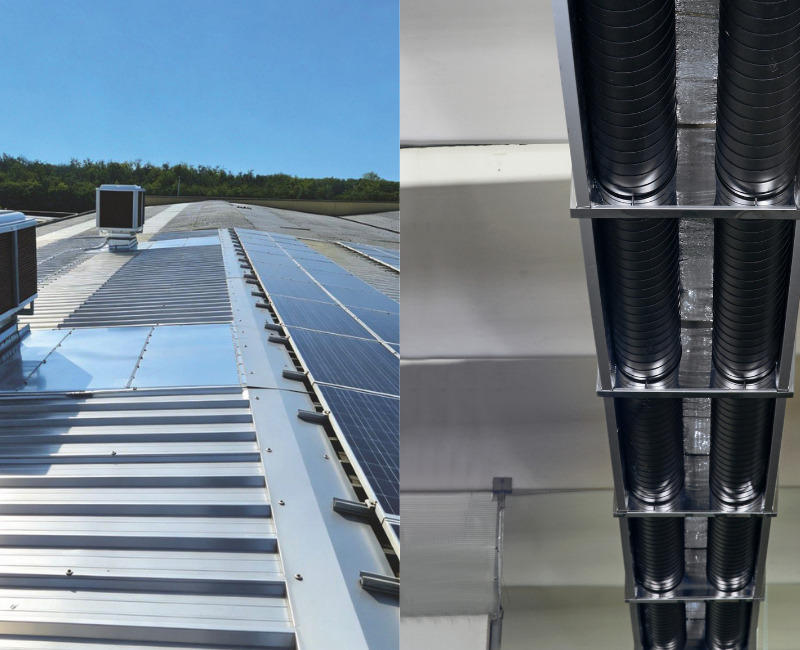
Models with the P configuration are designed for wall-mounted installation, while T models are intended for roof installation.
This flexibility makes it possible to identify the most suitable solution based on the building structure and the distribution of the areas to be cooled.
Depending on the model, the air can be directed using different outlet configurations, allowing the system to be designed according to the specific requirements of the environment.
Why Choose Evaporative Cooling for Industrial Applications?
In an industrial building or production environment, the goal is not necessarily to cool every single square metre, as would be the case with a traditional air-conditioned environment.
In many cases, it is more effective to target work areas and zones that are most affected by heat.
Evaporative cooling makes it possible to work with large volumes of air and can be used to improve comfort in a variety of environments:
- industrial plants;
- production facilities;
- workshops;
- processing areas;
- warehouses;
- logistics areas;
- covered sports facilities;
- environments with high indoor temperatures.
Naturally, system design must take into account the specific characteristics of the building and local climate conditions.
STAY COOL: A Range Designed for Comfort in Production Environments
The STAY COOL range by SIABS offers five models, with airflow rates from 5,000 to 27,000 m³/h and different installation configurations.
The choice of the most suitable system depends on the specific requirements of each project and should be assessed by considering the size, construction characteristics and intended use of the environment.
Thanks to the principle of adiabatic evaporative cooling, STAY COOL helps address the problem of heat in industrial environments through a technology that harnesses the natural process of water evaporation.
Temperature and Humidity: Two Key Factors in Evaporative Cooling
The performance of an evaporative cooling system depends on outdoor air conditions. In particular, temperature and relative humidity affect the ability of water to evaporate and, consequently, the cooling potential of the air.
In general, when outdoor air is hot and has lower relative humidity, the evaporative process can be more effective: the air has a greater capacity to absorb moisture, and the resulting cooling effect can be more significant.
The following table provides an indicative overview of the cooled air temperature that can be achieved depending on outdoor temperature and relative humidity, highlighting how the results of the evaporative process vary according to climatic conditions.
| Outdoor Temperature | 20% RH | 30% RH | 40% RH | 50% RH | 60% RH | 70% RH | 80% RH |
|---|---|---|---|---|---|---|---|
| 30 °C | 17 °C | 18.7 °C | 20.6 °C | 21.5 °C | 22.6 °C | 25.9 °C | 27.4 °C |
| 35 °C | 20.5 °C | 22.5 °C | 24.1 °C | 25.9 °C | 28.1 °C | 30.1 °C | 32.5 °C |
| 40 °C | 23 °C | 25.7 °C | 28.4 °C | 30.7 °C | 33 °C | 35.3 °C | 37.2 °C |
| 45 °C | 25.2 °C | 28.4 °C | 31.4 °C | 34.6 °C | 37.1 °C | 39.7 °C | 42 °C |
The values shown are indicative and are intended to illustrate the potential of evaporative cooling in relation to outdoor air conditions. Actual performance may vary depending on several factors, including the STAY COOL model used, evaporative pad efficiency, environmental conditions and installation characteristics.
This means that evaporative cooling is particularly interesting in environments where outdoor air conditions are favourable to the evaporation process, making it possible to lower air temperature without relying on traditional compression-based air conditioning systems.
Because when heat becomes a problem for the people who work, comfort is not optional.
Looking for the right STAY COOL solution for your environment?
Contact SIABS to assess together which model is best suited to your factory, warehouse or production area.
Discover the STAY COOL range and bring comfort where it is truly needed.