When it comes to heating an industrial, logistics or manufacturing facility, choosing the most suitable technology involves much more than simply considering the installed heating capacity.
Building height, the volume to be heated, insulation, frequent opening of loading doors, the presence of personnel in specific areas and the continuity of production processes are all factors that affect the actual efficiency of a heating system.
The main solutions available today include warm air heating systems, radiant panels, heat pumps and infrared radiant heating systems. Although they share the same objective — ensuring thermal comfort — these technologies transfer heat in very different ways.
Four Technologies, Four Different Ways of Transferring Heat
Warm Air Heating
Warm air heating systems heat an environment by introducing air at a higher temperature than the air already present in the space.
The principle is primarily convective: warm air naturally rises and circulates throughout the building.
This solution can be effective in certain settings, but it presents several challenges in large industrial buildings.
The main limitations of warm air heating in industrial buildings
1. Heating large volumes of air
In buildings with high ceilings, a large volume of air must be heated to achieve the desired conditions. Some of the warm air may accumulate in the upper part of the building, while people work at floor level.
2. Heat stratification
Warm air naturally rises. Without adequate air distribution or destratification, temperature differences can develop between the upper and lower parts of the building, potentially resulting in energy waste.
3. Heat losses when loading doors are open
In warehouses and logistics facilities, frequent opening of loading doors encourages air exchange with the outside. This can compromise temperature stability and require additional energy to restore comfortable conditions.
4. Heat distribution affected by obstacles
Machinery, racking systems and workstations can obstruct the circulation of warm air. Achieving adequate heat distribution therefore requires careful consideration of unit positioning and airflow direction.
5. Difficulty heating only occupied areas
If activities take place in specific areas, heating the entire building uniformly may be less cost-effective than using a solution designed to concentrate heat in operational zones. The ability to control separate areas depends on the system configuration.
6. Energy consumption linked to building characteristics
System efficiency depends on insulation, building height, air exchange rates, installed capacity and operating conditions. In very tall buildings or facilities with frequently opened doors, inadequate system design can lead to high energy consumption and insufficient comfort.
This issue becomes particularly evident in industrial buildings with high ceilings: a significant proportion of thermal energy may accumulate in the upper part of the building, while the areas occupied by personnel remain less effectively heated.
Radiant Panels
Radiant panels consist of panels or tubes suspended from the ceiling that transfer heat primarily through radiation. Generally installed overhead, they emit energy towards the surfaces and people in the area below.
Compared with warm air heating systems, the radiant principle allows more energy to be directed towards occupied areas.
However, performance depends on system configuration, operating temperatures and the characteristics of the building.
When comparing radiant panels with gas-fired radiant tube systems, another important factor to consider is the energy source and the way the system generates and distributes heat.
The main limitations of radiant heating panels
1. Heat distribution is not always uniform
In very large spaces, where workstations are spread across extensive areas, the layout of radiant panels can make it more difficult to achieve uniform coverage. Depending on the design and positioning, some areas may become warmer than others.
2. Reduced flexibility when obstacles are present
High racking systems, machinery, overhead cranes and internal structures can interfere with radiant heat distribution, creating thermal shadow zones. The positioning of radiant heating units must therefore be carefully planned.
3. Difficulty heating only the areas that need it
When personnel work in specific zones or different shifts, the ability to heat only occupied workstations effectively depends on the system configuration. A system with limited flexibility may result in unnecessary energy consumption.
4. Installation and maintenance constraints
Radiant panels require adequate installation space and clearances, as well as proper management of components and any combustion exhaust systems. In some industrial buildings, existing structures can make installation more complex.
5. Performance depends on system configuration
It would be incorrect to claim that radiant panels are always less efficient: results depend on building height, insulation, geometry, installed capacity and operating conditions. However, an incorrectly sized or poorly designed system may fail to provide the desired comfort or may consume more energy than expected.
Heat Pumps
Heat pumps transfer thermal energy from outside to inside a building through a refrigeration cycle.
They are a particularly attractive technology when a building is adequately insulated and relatively stable indoor conditions can be maintained.
In industrial environments, however, several factors require careful assessment:
- Very large volumes to be heated or air-conditioned.
- Building height.
- Frequent opening of loading doors.
- High air exchange rates.
- Outdoor temperatures.
- Available electrical capacity.
- The need to heat only specific operational areas.
In a large industrial building, it may not be necessary to bring the entire building volume to the desired temperature.
The main limitations of heat pumps in industrial buildings
1. Large volumes of air to heat
In buildings with very high ceilings, an air-source heat pump must heat the indoor environment to achieve the desired conditions. Heat stratification can cause warmer air to rise, while personnel work at floor level. The outcome also depends on air distribution and system configuration.
2. Heat losses when loading doors are open
In logistics and goods-handling areas, doors are frequently opened to allow vehicles and materials to move in and out. This increases air exchange with the outside and can make it more difficult to maintain a stable indoor temperature.
3. Response times and recovery of thermal comfort
When a building is very large or experiences frequent air exchanges, restoring the desired conditions can take time. Actual response depends on installed capacity, the technology used and the building’s characteristics.
4. Difficulty heating only occupied workstations
If personnel work in specific areas, heating the entire environment may be less targeted than using a system designed to deliver heat directly to operational zones. Heat pumps can nevertheless be configured for separate zones where the system design allows it.
5. Performance affected by outdoor temperatures
Air-source heat pumps may experience reduced efficiency and heating capacity as outdoor temperatures fall. Performance varies depending on the model and operating conditions, so system sizing must take the climate at the installation site into account.
6. The need for careful system design
To achieve good results, it is necessary to assess insulation, building height, air distribution, heating demand, air exchange rates and the facility’s operating profile. Inadequate design can result in insufficient comfort or higher-than-expected energy consumption.
This is precisely where radiant heating can offer a different approach.
Gas Radiant Tube Systems: Heating Where It Is Needed
SIABS radiant tube systems use the principle of infrared radiation to transfer heat directly to surfaces, people and the areas that need heating.
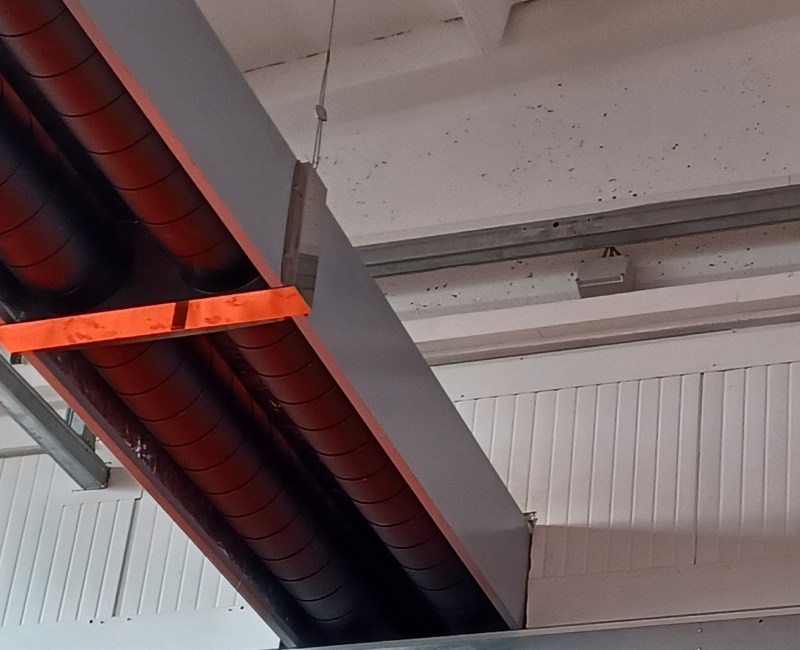
The system consists of a heat generator, installed outside the space to be heated, connected to a radiant tube circuit generally installed at ceiling level.
The generator produces hot gases that flow through the radiant circuit. The tube surface reaches its operating temperature and emits infrared radiation downwards.
This means that the entire volume of air inside the building does not necessarily need to be heated in advance to achieve a comfortable temperature in occupied areas.
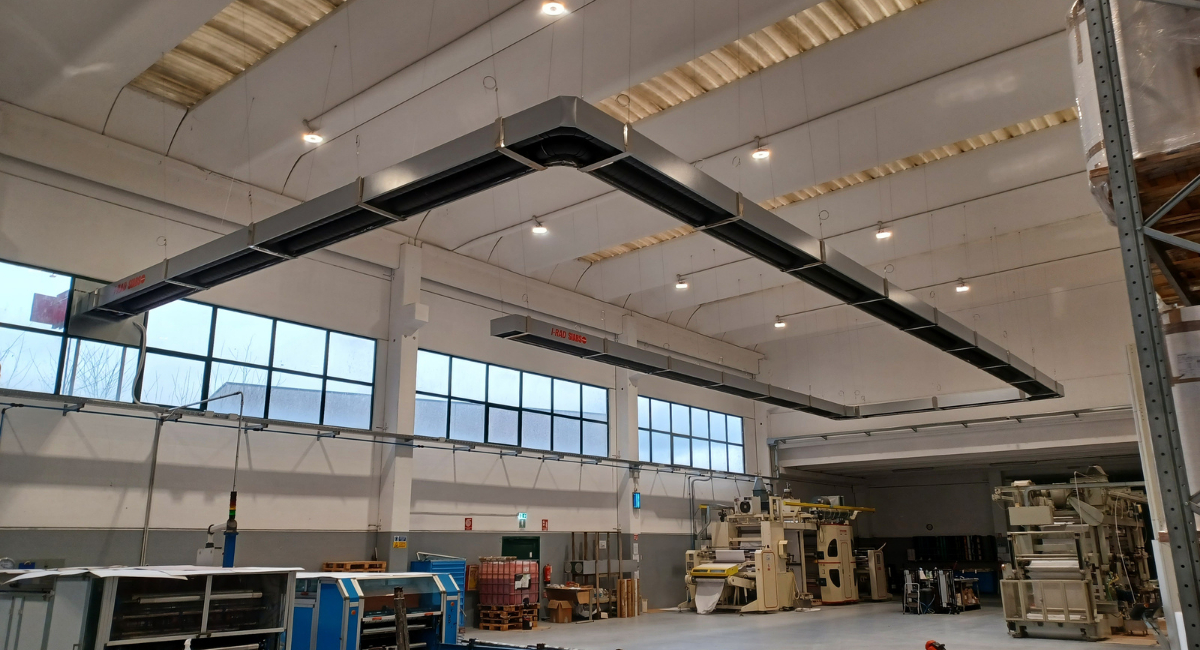
The Principle Is Simple: Less Air to Heat, More Energy Where It Is Needed
This is one of the main differences compared with warm air heating systems.
Radiant heat does not necessarily need to bring the entire building volume up to temperature. Instead, energy is transferred directly to the surfaces and people in the area concerned.
This approach is particularly interesting in:
- Large industrial buildings.
- Facilities with high ceilings.
- Logistics warehouses.
- Workshops.
- Manufacturing areas.
- Aircraft hangars.
- Buildings with limited insulation.
- Facilities where loading doors are frequently opened.
- Areas where only specific workstations or departments need to be heated.
The Advantages of SIABS Radiant Tube Systems
1. Heating through radiation
Heat is transferred through infrared radiation, without relying primarily on air circulation to distribute energy.
This makes it possible to concentrate the thermal effect more effectively in occupied areas, reducing the impact of stratification typically associated with convective systems.
2. Heating large industrial spaces
In large industrial buildings, heating the entire volume of air can require a significant amount of energy.
The radiant principle, by contrast, allows the system to be designed around the areas that actually need heating, with targeted distribution of the radiant tubes.
3. Lower sensitivity to frequently opened loading doors
When an industrial door is opened, the warm air inside the building can escape rapidly.
Radiant heating works differently: energy is also transferred to the surfaces and objects within the heated area.
This makes the technology particularly interesting for facilities characterised by frequent openings to the outside.
4. Reduced thermal stratification
In warm air heating systems, warm air naturally rises, concentrating part of the energy in the upper areas of the building.
With radiant heating, energy is transferred directly downwards from the radiant surface.
Heat is therefore perceived in occupied areas without necessarily having to bring the entire building volume to the same temperature.
5. No air movement required to transfer heat
Radiant heat transfer does not require the continuous movement of large volumes of air.
This helps reduce convective air currents and limit the recirculation of dust that can accompany systems based on air circulation.
6. Zoned heating
One of the most significant advantages for industrial applications is the ability to design the system around the different requirements of the building.
Not all departments, workstations or work areas necessarily need to be heated in the same way.
Radiant tube systems can be configured to serve the areas that are actually in use, allowing more targeted energy management.
7. Heat generator installed outdoors
In SIABS systems, the heat generator can be installed outside the space to be heated, while the radiant circuit is installed indoors.
This configuration keeps operational floor space clear and allows the system to be integrated into production environments where floor space is valuable.
8. Suitable for buildings with high ceilings
Radiant technology is particularly suitable for buildings with high internal ceilings, where convective heating has to contend with the natural stratification of warm air.
Radiant heat transfers energy directly downwards without requiring the entire upper volume of the building to be kept warm.
SIABS Radiant Tube Systems: Technology for Industrial Heating
The SIABS range includes solutions designed for industrial applications and for heating large spaces.
I-RAD radiant tube systems are available with outputs ranging from 80 to 300 kW, with tube diameters generally ranging from 250 to 315 mm and tube operating temperatures of approximately 100–295°C, depending on the configuration.
System design makes it possible to combine the heat generator, radiant circuit, heat distribution and temperature control according to the specific characteristics of the building and the user’s requirements.
There is no single ideal configuration for every industrial building. The choice of technology and correct system sizing must take into account floor area, building height, insulation, intended use, operating conditions and the areas actually occupied.
Which Heating System Should You Choose?
| Technology | Principle | Best suited for | Key factors to consider |
|---|---|---|---|
| Warm air heating | Convection | Spaces with limited volumes and good building airtightness | Heat stratification, heat losses and air currents |
| Radiant panels | Radiation | Industrial environments and operational areas | System configuration and energy source |
| Heat pumps | Thermal energy transfer | Adequately insulated buildings with relatively stable indoor conditions | Outdoor temperature, electrical capacity, building volume and door openings |
| SIABS radiant tube systems | Infrared radiation | Large spaces, high ceilings, operational zones and facilities with frequent door openings | System design and sizing |
The goal is not to heat more. It is to heat better.
Choosing an industrial heating system should start with one fundamental question: does the entire building volume really need to be heated?
In many industrial settings, the answer is no.
When the objective is to ensure comfort in occupied areas, at workstations or in production departments, gas-fired radiant heating offers a different approach: transferring energy directly where it is needed, rather than relying entirely on air movement to distribute heat.
This is why SIABS radiant tube systems are a particularly interesting solution for heating large industrial spaces, especially when building height, heat losses, door openings and the layout of the facility make simply heating the entire volume of air less effective.
SIABS: gas-fired radiant technology for industrial comfort.
From system design to manufacturing, SIABS develops Made in Italy solutions for heating large spaces, with an approach focused on efficiency, comfort and targeted energy management.