Analyses conducted by ENEA highlight a critical issue for companies: summer air conditioning can account for up to 40% of electricity consumption in industrial warehouses. In large-volume environments, indoor temperatures can easily exceed 35°C, with peaks above 40°C in cases of poor insulation and insufficient ventilation.
In this context, adopting efficient solutions such as SIABS Stay Cool adiabatic evaporative coolers becomes a strategic choice—not only for comfort, but also for economic and regulatory sustainability.
Microclimate regulations: an obligation for companies
Legislative Decree 81/2008 requires companies to ensure microclimatic conditions suitable for workers’ health. INAIL guidelines on heat stress define precise thresholds beyond which risks to safety and productivity increase.
Many non-air-conditioned industrial buildings regularly exceed these limits, making industrial cooling a regulatory necessity as well as an operational one.
The problem of heat in industrial warehouses
Rising summer temperatures are putting pressure on the industrial sector, where warehouse structures significantly amplify the effects of external heat. Metal roofing exposed to the sun absorbs large amounts of solar radiation, converting it into thermal energy that is then radiated inside the work environment.
During the hottest months, sheet metal surfaces can reach very high temperatures, and heat persists indoors even during nighttime hours.
The result?
A thermal buildup that the structure struggles to dissipate, keeping indoor temperatures high even after sunset.
Inside warehouses, poor ventilation further worsens the situation. Stagnant air hinders sweat evaporation, compromising the body’s natural thermoregulation process. Even in seemingly tolerable conditions, workers perceive stuffiness and discomfort.
From an energy perspective, traditional air conditioning is becoming increasingly challenging. Electricity rates for industrial users, ranging between €0.20 and €0.35 per kWh during daytime hours, make cooling an increasingly significant cost.
Beyond economic aspects, heat also affects workplace safety. Increased heat stress leads to reduced concentration, early fatigue, and slower reflexes—factors that contribute to a higher risk of accidents.
In this scenario, investing in efficient and sustainable cooling solutions is no longer just a matter of comfort, but a key strategy to ensure productivity, safety, and long-term competitiveness.
In summary, industrial buildings amplify heat due to several factors, including:
• Metal roofs reaching 60–70°C
• Greenhouse effect
• Poor ventilation and nighttime heat accumulation
• Stagnant air increasing the perception of humidity and discomfort
For this reason, it is extremely important to consider solutions such as evaporative coolers. Moreover, if you are planning production investments for 2026, you may benefit from hyper-depreciation: a government incentive that allows you to increase the tax-depreciable value of Industry 4.0 assets by up to +180%. Thanks to this incentive, you can achieve overall tax savings of up to 67%.
Air-based industrial cooling: a natural and efficient technology
Our industrial cooling system is based on a natural and highly efficient principle: evaporative cooling.
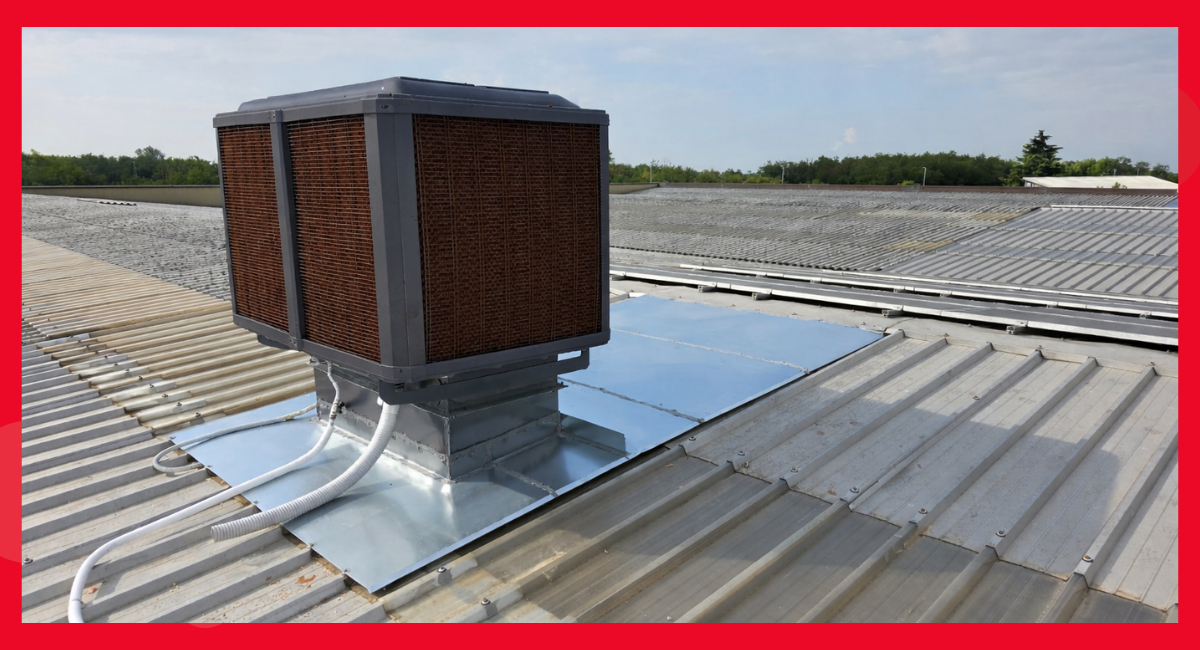
We use external air, which is drawn in and passed through special cellulose filters continuously moistened with water. This process, carried out via a cooler installed on the roof or external walls, allows the air to release part of its heat, naturally reducing its temperature. The cooled air is then introduced into the warehouse through a forced ventilation system.
Thanks to its higher density compared to the warm air present in industrial environments, it tends to sink downward, effectively cooling operational areas where people and machinery are located.
Meanwhile, hot air is expelled outside through openings such as windows and doors, ensuring continuous and natural air exchange.
Why are traditional air conditioners not suitable?
Traditional air conditioning systems show clear limitations in industrial environments:
• Ineffective with open doors and continuous goods flow
• High costs
• High energy consumption
• Complex maintenance and regulatory constraints
Stay Cool evaporative coolers: the efficient solution
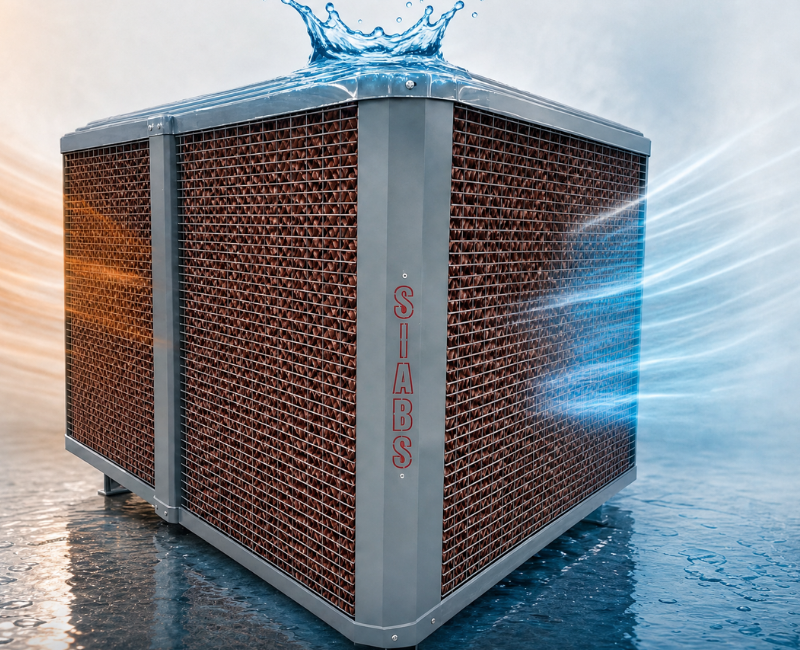
SIABS Stay Cool adiabatic coolers use the natural principle of water evaporation to cool the air.
How they work:
• External air passes through wet evaporative panels
• Water evaporates, removing heat
• Fresh air is continuously supplied indoors
This system allows for:
• Effective cooling even with open doors
• Constant air exchange
• Removal of hot air and contaminants
Investing in adiabatic cooling means improving business performance in a sustainable and competitive way.
This continuous cycle enables a significant reduction in indoor temperature, improving comfort and productivity in work environments.
In addition, the system helps maintain cleaner air, making it particularly effective in production settings where dust, fumes, or vapors are present.
An economical and versatile solution
The system is designed to ensure low energy consumption and extremely low operating costs, making it an accessible and cost-effective solution for cooling industrial warehouses.
Furthermore, its operation does not depend on continuous water usage, making it suitable even during mid-season periods.