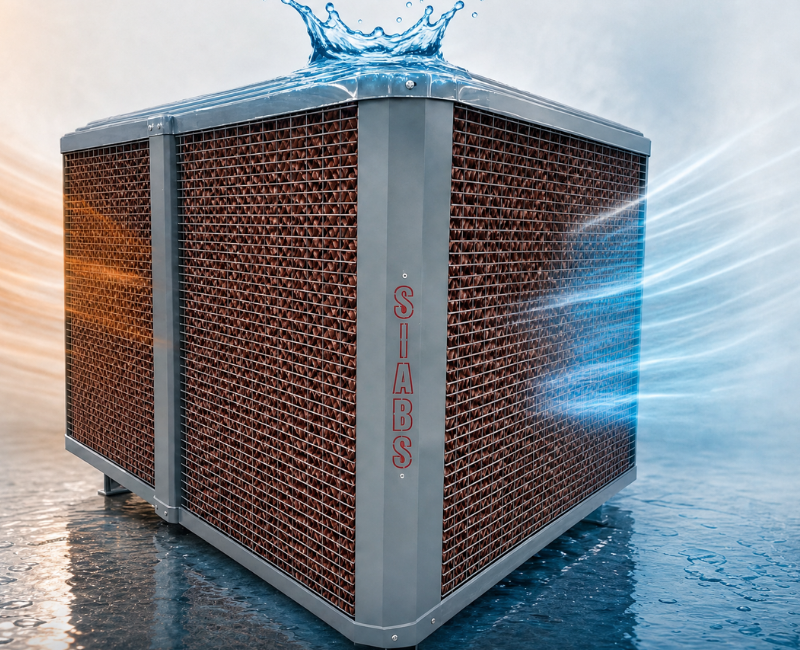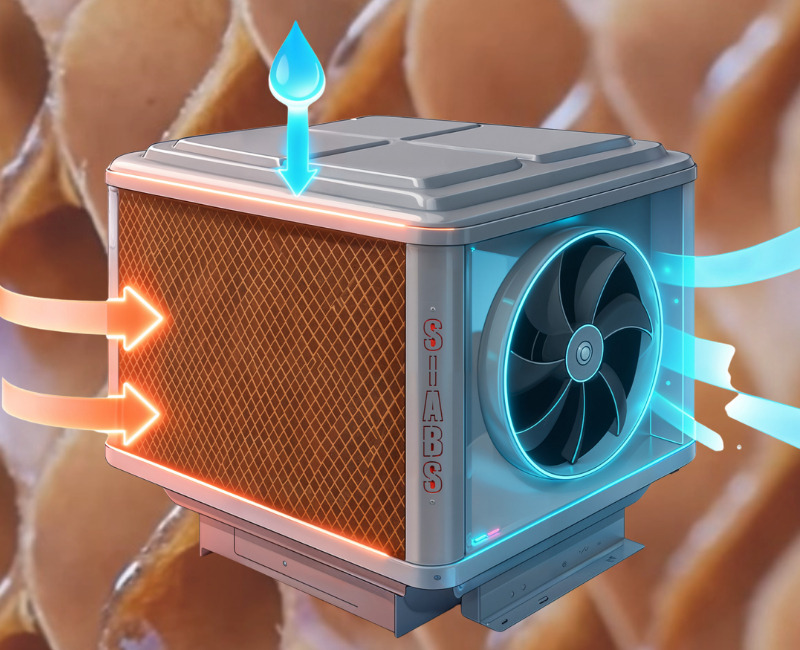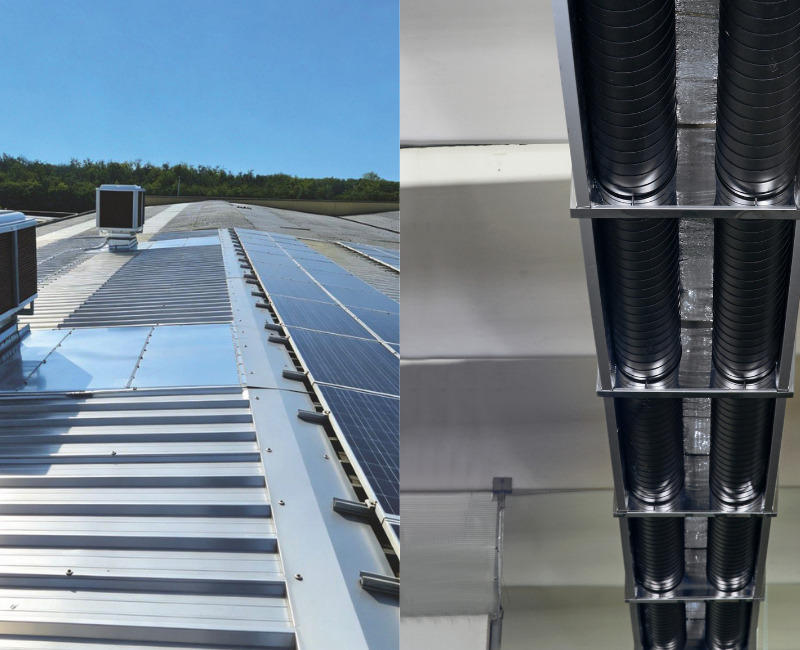
With rising temperatures and increasing energy costs, interest in alternatives to traditional air conditioning is growing. Among these solutions, SIABS evaporative coolers are becoming an increasingly popular choice thanks to their efficiency, sustainability, and natural comfort.
But how do they work, and why should you choose them? Here are 10 essential things to know about evaporative coolers.
10 Key Facts About Evaporative Coolers for Industrial Applications
1. They Are Not Air Conditioners: They Work with Fresh Outdoor Air
Unlike traditional air conditioning systems, evaporative coolers do not recirculate indoor air. Instead, they introduce fresh, filtered, and cooled outdoor air into the building. This ensures better air exchange, although performance depends on outdoor climate conditions.
2. They Perform Best in Dry Climates
The drier the air, the more effective the cooling process. In highly humid environments, cooling efficiency decreases because evaporation becomes less effective.
3. Very Low Energy Consumption
Compared to compressor-based cooling systems, evaporative coolers consume significantly less energy. Energy savings can often exceed 70–80% compared to conventional cooling systems.
4. Ideal for Large Industrial Spaces
They are particularly suitable for large, open areas such as warehouses, manufacturing plants, logistics centers, and workshops, where cooling individual workstations with traditional air conditioning would be inefficient or prohibitively expensive.
5. They Improve Indoor Air Quality
In addition to cooling, evaporative systems continuously introduce fresh outdoor air and help reduce dust, odors, and airborne contaminants, enhancing overall workplace comfort.
6. Proper Ventilation Is Essential
For optimal performance, hot indoor air must be allowed to exit the building through windows, vents, louvers, or extraction systems.
7. Simple but Necessary Maintenance
Filters, evaporative pads, and water tanks require regular cleaning and maintenance to prevent scale buildup, unpleasant odors, and bacterial growth.
8. Reduced Environmental Impact
Evaporative coolers use minimal electricity and water and do not require refrigerant gases, making them a more environmentally friendly solution than conventional air conditioning systems.
9. Different Comfort Experience Compared to Air Conditioning
Rather than cooling specific areas to a fixed temperature, evaporative coolers reduce the overall ambient temperature. As a result, temperature levels may vary slightly depending on airflow distribution.
10. Correct Sizing Is Crucial
Selecting the appropriate airflow capacity is essential. An undersized system will not provide sufficient cooling, while an oversized system may unnecessarily increase installation costs and energy consumption.
Why Choose Evaporative Cooling for Industrial Buildings?
Evaporative coolers are an excellent solution for industrial facilities when the goals are:
- Low energy consumption
- Continuous ventilation
- Reduced operating costs
However, they achieve their best performance only when properly designed and installed according to the local climate, building volume, and ventilation requirements.
At SIABS, we can help you determine how many evaporative coolers your facility requires or compare evaporative cooling with a traditional air conditioning system.
Why Choose SIABS Evaporative Coolers
Investing in a SIABS evaporative cooler means choosing a solution that is:
- Efficient
- Sustainable
- Cost-effective
- Suitable for a wide range of industrial environments
- 100% Made in Italy
Advanced Technical Features
- Pure cellulose cooling pads impregnated with special resins, resistant to UV rays, fungi, bacteria, and algae thanks to integrated biocidal and antibacterial agents.
- High-efficiency cooling pads that are versatile and easy to replace.
- Structural ABS housing that is lightweight, weather-resistant, and ideal for roof or wall installations with limited load-bearing capacity.
- High-efficiency fan system engineered to maximize airflow performance.
- Automatic water tank drainage and management system controlled by the machine’s power module.
- Custom-designed water distribution piping that ensures uniform wetting of the cooling pads.
A Smart Cooling Technology for Hotter Summers
As summers become increasingly hotter and energy efficiency becomes a growing priority, evaporative cooling continues to prove itself as one of the smartest technologies for industrial climate control.
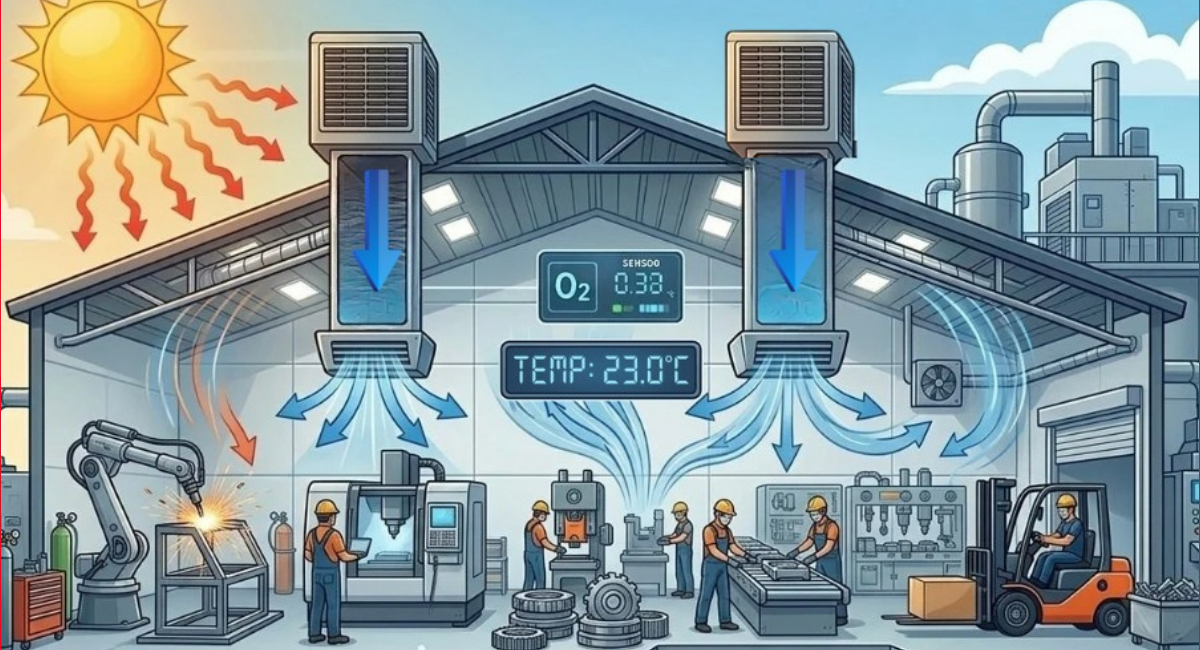
When calculating the thermal load of an industrial building, outdoor temperature is only one factor to consider. Heat generated by internal activities combines with heat gains from outside, contributing to the overall thermal load that the cooling system must manage.
Building characteristics and operational factors—including natural ventilation openings, high ceilings, loading and unloading areas, and production lines—also continuously affect the indoor microclimate and heat distribution.
This situation is common in many industrial facilities during the summer months. Even when outdoor temperatures begin to drop, indoor spaces often remain hot for a longer period due to accumulated thermal loads generated by daily operations. This ongoing heat buildup impacts both employee comfort and the continuity and efficiency of production processes.
Stay Cool: Industrial Adiabatic Cooling by SIABS
Our Stay Cool range of industrial adiabatic cooling systems combines performance, efficiency, and reliability, even in the most demanding environments.
Without the need for compressors or refrigerant gases, Stay Cool systems can reduce cooling costs by up to 75%, delivering sustainable and cost-effective climate control for modern industrial facilities.