In the industrial and commercial air conditioning sector, the choice of cooling system directly impacts energy consumption, operating costs, and environmental sustainability. More and more companies are considering a practical alternative to traditional compression systems: adiabatic evaporative coolers.
But why choose this technology over traditional heat pumps? Let’s analyze the advantages, differences, and application scenarios.
What industrial evaporative coolers are and how they work
Industrial adiabatic coolers use the principle of water evaporation to lower air temperature.
How they work:
- Warm air passes through wet pads
- Water evaporates while absorbing heat
- The cooled (and slightly humidified) air is released into the building
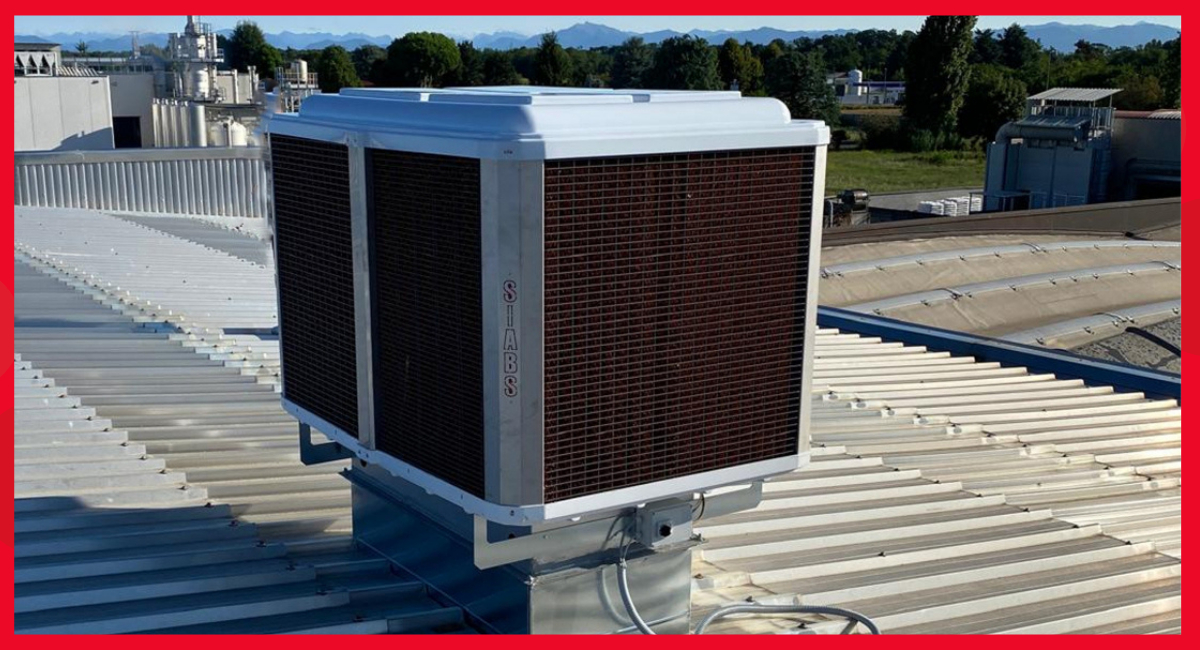
They consist of:
- Industrial fan
- Evaporative pads
- Water connection
- Electrical power supply
Typical applications:
- Logistics warehouses
- Workshops
- Manufacturing plants
- Large industrial buildings
Heat pumps: how they work
Heat pumps operate through a compression refrigeration cycle, using a refrigerant fluid to transfer heat from inside to outside (in cooling mode).
They are widely used in residential and commercial environments but often involve:
- High electricity consumption in large spaces
- Greater system complexity
- Higher maintenance costs
- The use of refrigerant gases
What are the advantages of choosing an adiabatic evaporative cooler?
1️⃣ Lower energy consumption
The first major advantage of evaporative coolers is energy savings.
An adiabatic system can consume up to 80% less energy than a traditional heat pump because:
- It does not use compressors
- It does not require refrigeration cycles
- It only consumes energy for ventilation and the water pump
For industrial buildings, warehouses, and workshops, this translates into significantly lower energy bills.
2️⃣ Constant air exchange and better air quality
Evaporative coolers operate with 100% fresh outside air, ensuring:
- Continuous air exchange
- Reduced CO₂ and pollutants
- A healthier environment for workers and customers
Heat pumps, on the other hand, often recirculate indoor air, resulting in less natural ventilation.
3️⃣ Lower environmental impact
The absence of refrigerant gases makes adiabatic systems more environmentally sustainable. Heat pumps use refrigerants which, if released, can have a significant environmental impact.
In the context of energy transition and ESG responsibility, this difference is becoming increasingly important.
4️⃣ Lower installation and maintenance costs
An adiabatic evaporative system is:
- Simpler
- Faster to install
- Less prone to complex mechanical failures
Routine maintenance is generally less expensive than that required for an industrial heat pump.
5️⃣ Ideal for large spaces
Evaporative coolers are particularly suitable for:
- Industrial warehouses
- Logistics centers
- Gyms
- Workshops
- Facilities with frequently opened large doors
In these environments, heat pumps often lose efficiency due to thermal dispersion, while adiabatic systems work effectively with continuous external air flow.
How to evaluate the right choice
Choosing between adiabatic evaporative coolers and heat pumps means evaluating:
- The size of the space
- Energy consumption
- Available budget
- Sustainability goals
For large industrial and commercial environments, adiabatic evaporative coolers represent an efficient, economical, and environmentally friendly solution, capable of ensuring comfort and long-term savings.
If you are considering a cooling system for your company, adiabatic evaporative technology could make a real difference in terms of costs and performance.
👉 Contact us for a personalized evaluation and a dedicated quotation.